Monday, October 7, 2013

Differentiating in the Digital Age

Sometimes, the task of differentiating instruction can be daunting.  It can be even more daunting when you are a teacher of literacy, and you have students covering an immensely wide range of abilities in reading and writing.  I've often grappled with trying to effectively reach and engage all students along this continuum without moving too quickly for some students, while at the same time not nearly quickly enough for others.  I found that no matter the pace at which I taught writing skills, there were inevitably always students who grasped the skill the first time through, and in the same breath, students who were desperately struggling to catch up. 

This summer, I took a course on teaching writing which emphasizes the writer's workshop approach, an approach I really connected with when keeping in mind the variety of students I have in my classroom.  This approach allows me to conference with students throughout the writing process, instead of waiting for them to turn in a rough or final draft to determine if a student needs help with a specific writing skill.  One of the things I love most about professional development is that I can take what I've learned and mold it to my style and craft as a teacher. And, if you know anything about my style and craft, you know it includes technology.

The pedagogy-changing decision I made to more fully incorporate technology and BYOD into my classroom has helped me enormously to facilitate the process of personalizing learning, and when combining that with the new strategies I've learned in the writer's workshop class, I've found great success in the teaching of writing in an inclusion classroom.

Right now, we are finishing up our narrative writing unit.  Students are working on developing their own personal narratives. Our slogan for this unit is: small moment, big meaning! We are working on a variety of skills, all of which students are learning at their own pace. 

Once the "from the heart" drafting is complete, students receive 2 checklists, one for revising, and one for editing.  I ask students to keep the checklists on their workspace the whole time they are working.  That way, I can get an at-a-glance picture of where students are in the process.

The revising checklist:


The revising checklist contains reviews of 3 mini lessons that were taught live the week before using mentor texts to demonstrate what great narrative writers do.  For this unit, we worked on setting the scene (writing interesting leads), digging deeper (adding figurative and sensory language, dialog, and thoughts and feelings), and so what?? (making sure our narratives have a purpose).  


Students were asked to watch a video, and revise thier drafts according to the strategies they just learned about.  Because the lessons were reviewed in the form of a video, students could watch them as many times they needed to, and most importantly, revise at a pace that works for them.

When the revision checklist was complete, they moved to their editing checklist...

This checklist added another dimension. Once they watched a video on an editing skill, they were asked to take a quick electronic quiz on their English edline page to check for understanding.  These were very quick, formative assessments that get reported immediately to me.  I can very quickly check in with students who are not understanding the editing skill, and reteach as necessary. 


There were an infinite number of reasons why I felt like this approach to teaching writing was one of the most successful I've tried so far. 

1. Students are truly working at their own pace. They know they are held accountable for all of the information presented, but they don't have to deal with the added stress of missing something important during the teaching of the lesson. For those students who find writing a natural and painless process, they are able to work through the revision process without the boredom of waiting for others to finish. 

2. I get to give immediate feedback.  While students are working on their checklists, I have the freedom to move around the room, and find those struggling students to conference with. Receiving the immediate feedback on the quizzes also helps me to identify where skills are strong and where they need further development both within the large group and amongst individual students.  I don't have to wait until all 105 quizzes are graded to find out who is struggling with a concept. 

3. The amount of "less with the jaws more with the paws" reminders I need to give my seventh graders during the revision process has been DRAMATICALLY reduced.  I get to spend less time making sure students are on task, and more time making sure they are truly building and growing their writing skills DURING the writing process, instead of waiting until it is complete.

It's pretty blissful, actually.  


Thursday, September 19, 2013

Beginning with BYOD

As a teacher entering the profession in the 21st century, integrating technology into my classroom has always been a priority of mine. When I was given the opportunity to participate in a districtwide Bring Your Own Device program 3 years ago, I jumped at the chance.  I quickly realized, however, that I had absolutely no idea what I was doing.  Even though I used technology every day to organize my personal life, I had little practical understanding of how to apply that to my classroom. I had many days where in four class periods, I accomplished absolutely nothing. In fact, many days I think I actually aided my students in the rarely practiced yet impressive art of unteaching. I left the building many days feeling frustrated and exhausted.  To put it frankly, it was quite terrifying. It was truly one of those learn as you go experiences, where you feel like you make a million mistakes before you can even take one hesistant step forward. Looking back, there are lots of things I would've told myself, and I'm hoping some of you can benefit from this retroactive advice!

1. Create and post routines, expectations, and procedures for using technology.
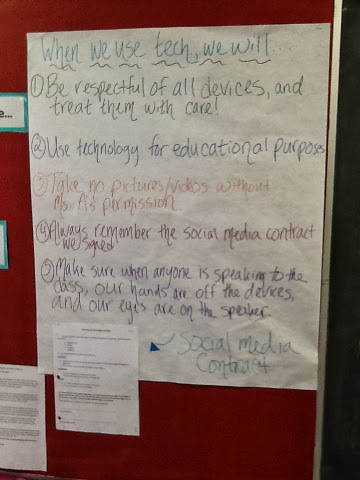
Duh. Of course setting routines, expectations, and procedures is important. It's the first thing we do to maintain management. But when I was in the excited frenzy of trying something brand new, I neglected to acknowledge that it needed to come with its own set of expectations. When my classroom had turned into Bedlam, I knew I needed to start over. Now, once my classroom is already running well, I spend time setting separate routines, procedures, and expectations specifically for using technology.  I start by asking my students to brainstorm how they envision using technology in our classroom, and what they think is important in order to keep our classroom running smoothly.  I like including students in this process to promote ownership and responsibility. I make a giant list of everything they come up with, and pool their ideas into a set of 5 simple, convenient, and visible expectations.

I also ask them to sign a social media contract, which is shaped by our school's core values of respect, responsibility, and honesty. 


As in all endeavors we take on as teachers, when students understand and agree to what's expected of them up front, it allows us to be proactive classroom managers, instead of forcing us to waste time and energy putting out fires all over the place.

2. Loosen your grip. You are now a facilitator.
I can't say this enough.  When you are incorporating BYOD into your classroom, it will get messy.  Like really messy. You'll have days where kids are unimaginably perplexed, and days where the app that worked perfectly last period is now not working for no solvable reason.  You'll have days where you will hear the same question asked enough times to make you want to rip your hair out. Just roll with it.  Thank your students for their patience, and stay calm. Remind them that you are all in this together, and we can learn from what went wrong today. Don't run to their rescue with step by step directions for each task. Don't answer the same question more than three times; direct them to a classmate for who has already received the answer. Otherwise, you will literally drive yourself insane. Ask them to problem solve and encourage them to try something before asking the inevitable question, "What do I click next??"

3. Teach and model technology etiquette.
You know when someone swears they are listening to you, and they nod their head giving the impression that they are listening, but at the same time scrolling through Facebook or checking their email? Then you discover, after blabbing on for quite some time, that that person has not truly processed one word of your hilarious story? That's similar to what happened in my classroom when I tried to give directions once students were fully engrossed by their devices. I think the most important expectation, and the one that takes the most practice, is that when anyone (student or teacher) is speaking to our class, hands are off our devices and eyes are on the speaker. It even takes practice for me, and I've had to train myself not to be playing around on my ipad while my students are asking me even the smallest questions.  By getting students in the habit of understanding there is a time and a place, we can help them to be respectful and responsible users of technology. We want them to be well versed in technology, while at the same time remembering how to respect and listen to one another.

4. Start small, and build slowly.
Don't try to incorporate BYOD in every facet of your teaching right out of the gate.  It will turn out a lot like learning to juggle by throwing 5 balls into the air at once.  It will fail miserably, and you might get hurt. Start by incorporating one app, and using it once or twice a week. When it's working really well, introduce something else. A great app to start with is Socrative, a response app that allows students to answer open ended questions and take quizzes using thier mobile devices.  It's very user friendly, and it works like a charm.


5. Learn and take advantage of social networking.
If I were asked to give one single piece of advice to any teacher at any point in their career, it would be to join Twitter.  You can create a Professional Learning Network made up of teachers from around the world. It's fantastic. It's like a daily mini dose of professional development.  It's a great place to share what you're working on in your classroom, and to experience what other teachers are working on in their's. As an added bonus, you can find out what Justin Timberlake ate for lunch, if you're interested in that sort of thing. Follow me @JennaleeA. I promise I won't share with you what I ate for lunch.

Other great social networking sites worth joining and exploring are:
-Pinterest (a virtual pinboard)
-Goodreads (Great for ELA teachers. Keep track of, review, and share books you're reading)

Although it's absolutely been a tumultuous journey, incorporating BYOD into my classroom has been incredibly valuable.  I love the idea that bringing devices into my classrom allows education to change and develop in the blink of an eye. Even more so, I love the idea that it allows me to instantaneously connect my students with the world around them. 


Wednesday, September 11, 2013

Starting Up Strong

Even though I am 5 years into my career as a teacher, and I've gone back to school on a yearly basis since kindergarten, the first day of school still carries that same nervous excitement I felt at 5 years old, standing in front of my house, waiting for the bus, wondering if Mrs. Minton would like me.  Only now, I find myself on the other side of the equation, and that nervous excitement is manifested in making sure my learning space is perfectly arranged, reading over my class lists, and trying to picture a fresh batch of seventh graders wandering into my classroom. 

It's obvious that those first days of school are imperative in terms of establishing routines and procedures and setting the overall tone of the classroom.  In years past, my focus has always been not only creating and practicing a procedure for just about everything, but also setting the tone by making sure my students knew that I was in charge.  My classroom door was adorned with only my name, room number and the class I taught.  When the students entered on the first day, I had the desks in rows alphabetically.  I read lists of rules, and tried my hardest not to smile. I had to make sure they knew that MY students need to follow MY rules in MY classroom. 
 
I have to admit, though I continued to start the year this way, it felt unnatural and unwelcoming. I found myself stumbling through the first days of school until I could get to that point in September where I could become my real teacher self.  So, I decided to try something different this year.  My teaching philosophy has evolved as I've learned more about being a middle school teacher, and my goal was to make sure my students' first days of school fit well with my mission of creating an inclusive and empathetic community of students. 

Door Deco
All year long, I change up what my door looks like.  It's one of my favorite features of my classroom. I wanted this to be a part of my identity as a teacher from the start. So, Instead of starting the year with my door displaying only my name, classroom number, and the subject I teach, I tried this... 


The Power of Pronouns
A pronoun can make all the difference in the world. I'm not just saying this because I'm an English teacher.  While looking over my class expectations document, I couldn't help but notice how many times I used the words: I, me, my, you, yours, etc.  From day one, I was already sending the message that it was me against them. The classroom was my classroom. You were responsible for bringing a pencil to class everyday.  In an environment where I was trying to encourage community, I felt like I was already tearing down the bridge I'd hope to build between students and teacher.  I wanted them to know that we are in this together, and that my responsibilites as a teacher are similar to theirs as students. I wanted them to know that this classroom belongs just as much (if not more) to them as it does to me. So, I infiltrated my expectations to send the message that we are on the same side, and we are working together to achieve success.  I changed the I's, my's, you's, and your's, to we's and ours. My expectations document used to open with classroom rules.  Now, the opening looks like this...


Starting as a Team
Teamwork is a huge a focal point in my classroom, and seating alphabetically by row on day 1 seemed counterproductive to establishing this important pillar of my philosophy of education. So, instead of standing in the front of the room explaining the different procedures and routines, to rows of students, I placed them in groups right away, and sent them on a scavenger hunt where they worked together exploring the classroom for answers to my questions. I've decided also to rename my daily objective to "Today's Team Goal", and to emphasize throughout class that we need to bring our individual best to the table to be collectively successful in achieving this goal.

Although this was experimental, I am really happy with the sense of unity and community that seems to already exist in my classroom seven days in. I hope that by constantly reinforcing that we are a team, and that we are all here to help each other achieve success.


Thursday, August 22, 2013

Taking Flight


In this last precious week of summer, I have had the opportunity to participate in a writing institute that has taught me, among MANY other things, that I need to take myself through the writing process on a regular basis in order to be a better teacher of writing. In this institute, we were asked to produce a narrative based on a small, significant moment in our lives.  Though I am constantly asking my students to write,  I forgot how cathartic it can be to sit down and write a story of my own, and then take it to the point where it feels like every word was perfectly chosen.  I'd like to share with you my small moment...


                                                                          Taking Flight


My phone croaked the familiar sound of a text message received, and slithered across the table as it vibrated. Do u think u can run to TJ Maxx and grab me a bathingsuit?? I read the message with growing irritation as I checked my watch: 3:30. Two hours before departure. Fine.I replied. The period at the end was meant to punctuate my annoyance. I had been nagging him for weeks to make sure he had everything he needed for our trip.


Fully expecting this last minute item request, I hopped into my car and raced to the South Bay Shopping Center, predicting the inevitable traffic jam through Andrew Square.


It was going to be my first trip to Europe, and it was full of questions. Not the kinds of questions you ask one right after the other, but the kinds that encompass your brain and linger all at once, like a dark, portending cloud.

Do I have everything packed? What if we miss our flight? Why didn't he buy a bathingsuit ahead of time like I suggested? What if we get lost while we're there and no one can help us ‘cuz we don't speak Greek and our phones won't work? What if I get bitten by a Greek spider and I get some sort of weird infection? What if they lose my luggage and I don't have my contact solution? What if the food is bad?


After purchasing the only bathingsuit left-why did they have such a terrible bathingsuitselection in July? Isn't it still summer? I punched it into his suitcase and we rolled out of our apartment, headed for Logan Airport.


More questions continued to race as quickly as the cars passing us in the tunnel. Some I knew were ridiculous, some I just had to have answers to.


"Do you think we should have dinner when we get to the airport? Or will we have an in-flight meal?" I asked him, trying to sound breezy.


"I don't know. We'll figure it out."


I turned and looked out the window, frustrated with this nonchalant answer to my very important question. I couldn't understand why he wasn't concerned about making sure every moment of this trip was just right. How can he not be worried about this? Should we stop and get a snack in terminal just in case?


With half an hour to spare before boarding, we arrived in the gate area.


"Let's grab a beer and start our trip off right!" He suggested excitedly.


I immediately snapped back, "We don't have time! What if they start boarding and we’re not there?"


"Relax, we'll make it," he responded. Cool as a cucumber. But I couldn't relax. So much moving forward from this point was unpredictable and, quite literally, foreign.


So much was beyond my control.


I rigidly sipped my Stella Artois between double and triple checks of my purse and carry on, making sure I had the important items I already knew I had. I could feel him becoming more and more disappointed with my inability to enter vacation mode, and it was beginning to plague the start of our trip.


After settling our tab and making just one more bathroom visit before boarding, we headed to our gate, my nervous stomach churning. Did they already start boarding? Did I leave my passport on the bar? I checked for it again, stopping so short that he crashed into me.


"You have it!" He said sternly.


As I quickened my pace heading towards the gate, I spotted what appeared to be a blur of orange t-shirts and lanyards pooled like a school of fish. The back of the t-shirts read something to the effect of "La Escuela de Madrid." It was my biggest nightmare: approximately 50 middle school students from Spain gathered on a school trip. Oh great. This is an overnight flight! What if they keep me up all night on the plane? What if I'm so overtired I can't even enjoy my first night in Greece?


I marched towards the boarding area, huffing and puffing, irritated at my bogus stroke of luck. I teach middle school. Don't I deserve a break from these kids? I merged into the line to board, ready with my passport and boarding pass in hand, eyes angrily focused on my clan of travel companions.

As I watched, something within me shifted and I softened.


​A few girls in the pack were busy with the all-important task of taking “selfies,” with their BFF’s.  A lanky teenage arm was stretched out to steady the camera, their heads weresquished together awkwardly, and they flashed their imperfect smiles (complete with braces and minor skin imperfections) over and over again.

​A group of boys nearby had just purchased a rainbow of soft drinks from the Sbarro next to the gate, and mixed them all together into an unsuspecting empty cup. They dared one another to gulp what now looked like fizzy mud, and when they did, they were completely oblivious to the fact that the girls were admiring their bravery from afar.  Once the challenge was complete, they relentlessly began poking, prodding, and pushing each other, unaware of the adult travelers they were getting in the way of.  Even though they only spoke in Spanish, I understood. Theyspoke the language of middle school.

​

They were unafraid to lose control in their laughter, and they let moments of hilarity completely envelop them.  They were forgetting their drawstring carryon bags in places they couldn’t remember leaving them, and glancing around perplexed as to how it could’ve gotten away from them.  They were tripping over invisible obstacles on the airport floor without regret for the path they took.  


They were carefree.


They returned me to the place in this world where I am positive, comfortable and accepting of what comes my way. Where there are more questions than answers, where things are forgotten or done at the last minute, and where almost nothing goes exactly as planned: my classroom.


It was the only moment leading up to this trip that was able to shake me from my ridiculously pessimistic and neurotic funk. Though they didn’t speak English, they told me something in that airport and in that moment: sometimes the best way to improve the future is to enjoy the present moment. Sometimes the best way to take flight into the unknown is to remember to stay grounded.


Tuesday, June 11, 2013

Sweat the Small Stuff

On my kitchen counter, I have a day to day calendar entitled "Don't Sweat the Small Stuff."  I tear off each day just before I leave my apartment to head into work.  The short quotes and daily guidance help me to start the day on a positive note, and to remember the big picture (preparing children for their futures) when dealing with the occasional annoyances and frustrations that can sometimes come with being in education. Ironically, and perhaps to the disappointment of the author of my daily calendar, I've found that to keep my focus on the big picture, I find myself paying special attention to, or I guess you could say "sweating," the small stuff.  Sometimes, keeping the big picture in mind is not about the amazing lessons we plan or the projects we assign. Sometimes, it's about paying attention to the small stuff.

The Welcome Wagon
At the beginning of each class period, and as often as possible, I like to station myself outside of my classroom, and try to greet as many of my students as I can.  Even though this can most definitely be categorized as a small part of my day, in my opinion, it makes a big difference.  It opens the lines of communication, and contributes to a classroom culture where students feel welcome and comfortable entering their learning environment.


A Picture is Worth a Thousand Words
We all know that displaying student work makes children feel proud of what they've accomplished in our own classrooms. However, I don't think displaying student work needs to be limited to work created for my class.  In fact, putting students on display doesn't have to be done in the form of work at all.  I like to hang up pictures of students' proud or silly moments...


I also love to hang up masterpieces they've created in art class...
                                   

It's important to me that my students know that room F10 belongs just as much (if not more) to them as it does to me, and this is one way to make them feel this importance. 

Words of Wisdom
As an English teacher, it's no shocker that I value the power of words (Exhibit A, this blogging habit I can't seem to shake!) I love having meaningful words displayed everywhere, and I mean everywhere, in my classroom.  When students have a moment or two where they tune out, as much as I'd  like to believe this never happens, I'd prefer that their eyes land on something that inspires them, rather than the piece of leftover lunch that has crusted over on their t-shirt.  

If their eyes wander to the clock, they see this...

If they become intrigued by something on my desk, their eyes may land on this...


If they are scanning stage right, they may land upon this...

And if they are glancing towards the left hand side of the room, they will see this...

The words of wisdom in my classroom aren't just for my students.  They also help me stay focused on what's important. Though it is our intention for our students to come first in every choice we make as teachers, we are human, and sometimes we may momentarily lose sight of this because of whatever is going on in our lives outside of the classroom or with the adults in the building.  As a constant reminder, I've provided some words of wisdom, just for me, to help me stay focused on my mission as an educator...


These words of wisdom, though a small touch, help me to stay focused on the big picture, and not to get wrapped up in whatever distractions may present themselves. 


The Smile File

We all know what it's like to feel defeated as a teacher. We know what it's like to be sure we are fighting an uphill and underappreciated battle.  We've all received that parent email (you know what I'm talking about; the one that makes you feel as though you're the worst teacher in America.)  We've all made mistakes as educators. We've all had bad days.  At the risk of being dubbed a pack rat, I will admit that I save every single piece of positive feedback I receive, from emails to thank you cards to hand written notes from students (literally everything) and put it in a photo album type booklet.  I like to pull this out when I'm feeling particularly like already been chewed gum stuck to the bottom of a very old shoe. It's a small thing that helps me remember the big picture.

I also like to keep a book of the hilarious things that the kids say, because there's no possible way I'd be able to remember them all.  I try to write these one liners down soon after they are delivered, and I relive those moments when I'm having a bad day, or when the kids and I just aren't on the same page.


When looking at the big picture, a successful classroom may be described by discussing the make up of the lessons we teach, the 21st century skills we integrate, and the expectations we set.  Believe me, all of these things are absolutely vital, and are the basic fabric of a flourishing learning environment. However, in my opinion, it's sweating the small stuff that takes a classroom from its basic fabric to one that is colorful, meaningful, and memorable.


Wednesday, May 29, 2013

The June Survival Kit

My last few blog posts have been geared towards making it as a middle school teacher through using creative teaching tactics and making connections with our students.  Though this is the "stuff" of good teaching, there are some other ways that, as middle school teachers, we need to make it.  Ok, I'll say what we are all thinking: we need to make it to June 25th.

Here in Boston, it's looking as though tomorrow is going to be a scorcher.  Right now, many of us teachers are facing the next couple of weeks with some apprehension as we inch towards the last day of the year. A building full of middle schoolers, 90 degree heat, and no air conditioning is a very frightening combination.  We are facing the days when we need to shower both before AND after work (the latter being a freezing cold one) even though we probably didn't have time to work out.  We are facing the days where we are reminded of the fact that the windows in our classroom only open half an inch.  We are facing the days where we don't blow dry our hair because we know it's immediately going up into some sort of makeshift updo as soon as we enter our sticky buildings.  How do we survive these weeks?  Well, we need to make it somehow, and there are a few key items that have helped me make it in the past.

Here it is...The June Survival Kit!


1. Hydration Station: It's important to stay hydrated once the school becomes Jamaica-like. Get yourself a very large, reusable water bottle.  Use it all day long.  In the morning, I like to make myself a giant iced coffee that fills this whole sucker up.  Here's a tip for you coffee lovers: ice melts VERY quickly on a warm morning in June.  I like to brew my coffee the night before.  Before putting it in the fridge, I fill up an ice cube tray with coffee, and stick it in the freezer.  So not only do I have deliciously cold coffee in the morning, I also don't have that watered down effect.  Once I'm fueled for the day, I like to alternate between water and the individual Crystal Light packets. 


2. Scent Defense: I'll be first in line to say that I love my students, and that I think they are amazing human beings.  However, being 13 and 14 years old, they don't always smell like roses.  This particularly comes to light around noon time on a sweltering day in June.  Air fresheners like the one pictured above are super cheap and can be strategically placed throughout the classroom.  I like the "four corners" approach, and I also keep one on my desk.


3. Fashion Friendly Breathability Gear: Thankfully, beach attire is not appropriate at school, although the temperature can reach beach friendly heights.  On those days, I try to wear the most breathable fabric possible.  The two items pictured above are my most comfortable for scorchers.  They are flowy (and thus non-stick) and light, yet are still appropriate and professional.  


4. Anti-Oil Agents: At school in June, it is almost impossible to keep from "glowing." No, not glowing because you know you'll be on the beach in a few short weeks. You know, that slick, oily feeling your face gets after about an hour on a humid day? There are lots of different brands of oil absorbing sheets that are a quick fix for this problem, and can help you feel less slimy as you make your way to 2:30.  If you don't have any in your purse or in your desk, you're in luck! Those brown paper towels that don't seem to easily absorb any spill that occurs in your classroom are, ironically, excellent for absorbing oil! 


5. Photos of your Summer Happy Place: For those increasing moments in June where you feel as though all children have completely tuned you out, and the 90 degree stagnant heat is slowly sucking the life out of you, turn your oscillating fan directly onto your face and pull out a picture of your favorite summer spot.  Mine is Duxbury Beach.  I let the cool(ish) breeze wash over my slightly slimy face, and picture myself driving over this bridge and into paradise.  After a couple of yoga breaths, I'm able to return to being calm, cool, and collected. 

Though education is our passion and our art, even the most dedicated of creators are faced with trying times and the need to recharge their batteries.  To me, many of those trying times in a teacher's journey come in June, as our students (and we) become more anxious for some rest, relaxation, and recharging.  Sometimes the best thing to do to feed our passion for education is to step away from it for a while, and to then be reminded of how much we love what we do. 


Thursday, May 16, 2013

Metaphorically Speaking

With the weather warming up and the motivation amongst students winding down, the end of the school year comes with lots of challenges.  Right now, I am smack dab in the middle of my 8th grade Romeo and Juliet unit, a unit that often comes with teaching more abstract aspects of language, and requiring students to do more reading between the lines.  In my inclusion classroom, grasping abstract concepts is something that usually only a handful of students are able to easily do.  Many of my students can fully access these abstract concepts when they are presented in a more concrete way.

In act 2, scene 2 of Romeo and Juliet, Romeo (who, in this scene, my students refer to as a "creeper") spies on Juliet as she swoons over him from up in her balcony.  Once she realizes he is there, they pour their hearts out to one another and proclaim their infinite love.  After listening to the scene as a class, we identify together the various metaphors that Romeo and Juliet use to express their love for one another.  However, in order to truly grasp just how gushy Romeo and Juliet's love for one another is, finding the metaphors isn't enough.  This means little to nothing to the students who think primarily concretely and cannot grasp the ambiguity of the metaphor. They need to see the metaphor, right there in front of them, to really understand what it means.

How can students see something metaphiorical? In trying to answer this question, I developed, what I've found to be, an activity that appeals to the masses (and by masses I mean my 50 eighth graders).

Students have 2 choices for this activity:

The more artistic students choose to actually illustrate a metaphor in it's literal form.  They read the metaphor, visualize what's happening, and put that visualization to good use by illustrating it.   Here are some works in progress...
                                    
   
"O swear not by the moon, th'inconstant moon,
Which monthly changes in her circled orb,
Lest that thy love prove likewise variable"

                                     
"Two of the fairest stars, in all the heavens,
Having some business, do entreat her eyes
To twinkle in their sphere till they return."

The other option students have (and my personal favorite choice!) is to photograph their interpretation of 4 metaphors from the scene.  They were asked to post their photographs to Instagram, and use an appropriate hashtag to distinguish each of my two groups' metaphors from one another (my two groups which have recently been renamed the Capulets and the Montagues.) They worked on these in class today, and really ran with.  They were hilarious.


 Take a look at what they came up with..


One of my personal favorites...


They even used photo editing apps to enhance their work...


Creating something concrete that represents an abstract concept has been a great way to help bridge the gap between the developmental differences in my classroom.  For those students who can easily perceive abstract information, this is a great extension activity for applying that comprehension.  For those students who struggle with reading between the lines, this is a great activity for clarifying understanding. And plus, it's fun!