On Friday afternoon, I took the opportunity to do something I haven't done in a really, really, really long time. I watched a teacher teach. I didn't read about a teacher teaching, I didn't participate in a meeting about teaching, I didn't favorite a Tweet about great teaching, I didn't even watch a video clip of a teacher teaching. I actually watched a teacher teach from the beginning of the class period until the end. I know it sounds crazy, but it's true.
As an undergraduate, I had spent some time observing teachers, but was shortly thrown into student teaching the second half of my senior year, and forced to tread water. Don't get me wrong, this was a fantastic experience in learning what not to do, and in figuring out how much I really didn't know how to do. It wasn't until I graduated college and couldn't find my first job as a classroom teacher that I truly began to feel ready to be one. In late August, I finally found a position as a paraprofessional, and it turned out to be the stepping stone I needed. Every day, for an entire school year, I got to watch teachers teach. I got to see how teachers began their classes, assessment tools they used, and behavior management systems and strategies. I got to see how teachers reacted to the unexpected, and what really happens when there is a substitute teacher in the classroom. I spent 180 days in a variety of classrooms, watching teachers with a variety of strengths, and my approach to education began to become a sort of patchwork of best practices. I had so many ideas that I actually saw working, and I couldn't wait to have a classroom of my own. I promised myself I'd continue to learn in this way, and I was off to start my first job.
Then, I became a real life teacher, and I just didn't have time anymore. Observing other teachers became a "maybe if I have a free period," and then other more important tasks simply took precedence. After Friday, however, I know now that I need to reorganize my instructional priorities, and that watching teachers teach was and still is the best way to learn.
As a teacher in a semi-paperless classroom, I was interested in seeing how a paperless classroom other than my own actually worked in practice. Enter Kerry Gallagher, a paperless teacher just across the street from me at the high school (who has a fantastic blog.) In two minutes, I was able to leave the four walls of my classroom, and get some quality mid-day professional development. At first I found it sort of awkward to not be the instructor in the room; I was so used to getting the class started, and checking in with students along the way. I was so used to being in charge. It took a lot for me to sit back and watch, especially when many of my former students were in the classroom. However, it was really fascinating to see the classroom from a learning perspective, and learn I did.
I've attended a lot of workshops, read a lot of books, and scroll Twitter every day feasting on the banquet of knowledge there is out there on education. I love it, and I learn so much. As valuable as this is, I can't help but feel that consistent peer observations are the one thing missing from my development as a professional. I loved seeing a class from start to finish, and seeing the similarities and differences between Kerry's instruction and my own. I loved seeing Kerry's approach to "paperlessness," and I love the fact that I came away from a 50 minute class period with new ideas for my own classroom. I can't help but feel as though engaging in this experience more often would be invaluable to improving my teaching. It would be amazing for this to be commonplace in schools across the country. I think we'd realize just how much we truly can learn (for free!) from one another.
Through this experience, one thing became more clear to me than ever before. TEACHERS NEED TO DO THIS! Not once in a while, not once a year, but as often as possible.
Monday, March 24, 2014

Saturday, December 14, 2013
One Year Ago
This morning, after a night of decorating my Christmas tree and getting ready for a holiday celebration with friends, I found myself thinking about where I was one year ago today. It was 2:30pm, and the end of another school day. Another blur had passed of teaching 5 classes, rushing around the building looking for a free copy machine, and hoping to have enough time to finish my lunch. Two students stopped by after the bell rang and asked, "Did you hear what happened today, Ms. A?" At this point, I had not. I didn't know that someone had entered an elementary school in a town eerily similar to my own with a mission to kill. I didn't realize that after 27 years, I hadn't seen and heard on the news the worst of the evil that exists in this world. "Why would someone do something like this?" They asked me. I didn't have an answer for them then, and I still don't.
I knew entering this profession that there would be days were I'd experience and have to respond to the unexpected. I knew there would be times when I'd find myself on the spot trying to explain things I couldn't explain. But I never imagined the degree to which this might be necessary, and I instantly saw myself in the shoes of Victoria Soto, the 27 year old teacher who was killed protecting her students. I spent the commute home that day listening to the news on the radio, sobbing in disbelief, and with the deepest sadness I had ever felt for teachers, parents, and children I had never met. While thinking about this moment one year later, I've realized that although it was and still is one of the most sickening feelings I've ever felt, not only as a teacher but as a human being, the only way I can respond to this that will have any significance is through learning from it, and through committing to keeping positivity, problem solving, and kindness a priority in my own life and in my own classroom.
As teachers, it's so easy to get caught up in our daily routines. We wake up in the morning, drink our coffee on the way to work, and before we even have a chance to speak our first words of the day, there are children at our doors waiting to ask us questions about last night's homework, or emails in our inboxes from parents expressing concern over a recent quiz grade. It's so easy to turn to negativity and blaming when we are struggling with our students or with our workload, and it's so easy to get into a cycle of complaining when things just aren't going our way, or when people just don't understand what we deal with. It's easy, but when the dust settles, it's exhausting, and it eliminates the opportunities we have to truly make a difference in the lives of our students. On December 14th, 2012, I never realized more clearly that the more time we spend focusing on problems and not solutions, the more we are ignoring students that truly need our help, and the more we are slowly squeaking open the doors of opportunity for another something tragic to happen in our schools.
It may seem like a huge monster to tackle, eliminating the possibility of violence in our schools, but it's not impossible. According to the US census, there are 7.2 million teachers in the United States, 3 million of which are teaching at the elementary or middle school level (http://www.census.gov/newsroom/releases/archives/facts_for_features_special_editions/cb11-ff15.html) There are THREE MILLION of us who teach at this crucial time in a child's development, and who have the opportunity to impact what kind of human being each child will be. Every moment we spend complaining about how frustrated we are with that child in our classroom who is defiant or disrespectful is a moment wasted in trying to understand that child's behavior and searching for a solution. I'll be the first to say that it's much more difficult to relentlessly search for successful interventions than it is to harp on the disbelief that these behaviors are still occurring in my classroom, or to blame lack of success on lack of support in our classrooms. It's more difficult to run a classroom that focuses on educating the whole child than it is to run a classroom that focuses on academics only. I can't lie and say that I don't find myself sometimes falling back into that pattern. It's certainly more difficult, but now more than ever, it's more important. We have so little time in our days as teachers to truly and collaboratively problem solve and support one another, how can we justify a minute wasted? Students spend a majority of their waking hours in our classrooms. How can we justify only teaching them how to individually read, write, and multiply instead of teaching them to work as a team and look out for one another? If there are three million of us who are willing to take the more difficult path, or at least look in that direction, there is no way we can fail.
Although I am still devastated to think about what happened in Newtown, Connecticut one year ago today, and I am still brought to tears when I try to understand how the young man who did this never got the help he really needed, I know that as a teacher, I can play a small role in possibly preventing this from continuing to happen. For the 107 students I will have over the next two years, I can make it a priority to dedicate myself to not only making sure my students are meeting the standards of the Common Core, but also to making sure my students are kind, grateful, helpful, and empathetic human beings.
I knew entering this profession that there would be days were I'd experience and have to respond to the unexpected. I knew there would be times when I'd find myself on the spot trying to explain things I couldn't explain. But I never imagined the degree to which this might be necessary, and I instantly saw myself in the shoes of Victoria Soto, the 27 year old teacher who was killed protecting her students. I spent the commute home that day listening to the news on the radio, sobbing in disbelief, and with the deepest sadness I had ever felt for teachers, parents, and children I had never met. While thinking about this moment one year later, I've realized that although it was and still is one of the most sickening feelings I've ever felt, not only as a teacher but as a human being, the only way I can respond to this that will have any significance is through learning from it, and through committing to keeping positivity, problem solving, and kindness a priority in my own life and in my own classroom.
As teachers, it's so easy to get caught up in our daily routines. We wake up in the morning, drink our coffee on the way to work, and before we even have a chance to speak our first words of the day, there are children at our doors waiting to ask us questions about last night's homework, or emails in our inboxes from parents expressing concern over a recent quiz grade. It's so easy to turn to negativity and blaming when we are struggling with our students or with our workload, and it's so easy to get into a cycle of complaining when things just aren't going our way, or when people just don't understand what we deal with. It's easy, but when the dust settles, it's exhausting, and it eliminates the opportunities we have to truly make a difference in the lives of our students. On December 14th, 2012, I never realized more clearly that the more time we spend focusing on problems and not solutions, the more we are ignoring students that truly need our help, and the more we are slowly squeaking open the doors of opportunity for another something tragic to happen in our schools.
It may seem like a huge monster to tackle, eliminating the possibility of violence in our schools, but it's not impossible. According to the US census, there are 7.2 million teachers in the United States, 3 million of which are teaching at the elementary or middle school level (http://www.census.gov/newsroom/releases/archives/facts_for_features_special_editions/cb11-ff15.html) There are THREE MILLION of us who teach at this crucial time in a child's development, and who have the opportunity to impact what kind of human being each child will be. Every moment we spend complaining about how frustrated we are with that child in our classroom who is defiant or disrespectful is a moment wasted in trying to understand that child's behavior and searching for a solution. I'll be the first to say that it's much more difficult to relentlessly search for successful interventions than it is to harp on the disbelief that these behaviors are still occurring in my classroom, or to blame lack of success on lack of support in our classrooms. It's more difficult to run a classroom that focuses on educating the whole child than it is to run a classroom that focuses on academics only. I can't lie and say that I don't find myself sometimes falling back into that pattern. It's certainly more difficult, but now more than ever, it's more important. We have so little time in our days as teachers to truly and collaboratively problem solve and support one another, how can we justify a minute wasted? Students spend a majority of their waking hours in our classrooms. How can we justify only teaching them how to individually read, write, and multiply instead of teaching them to work as a team and look out for one another? If there are three million of us who are willing to take the more difficult path, or at least look in that direction, there is no way we can fail.
Although I am still devastated to think about what happened in Newtown, Connecticut one year ago today, and I am still brought to tears when I try to understand how the young man who did this never got the help he really needed, I know that as a teacher, I can play a small role in possibly preventing this from continuing to happen. For the 107 students I will have over the next two years, I can make it a priority to dedicate myself to not only making sure my students are meeting the standards of the Common Core, but also to making sure my students are kind, grateful, helpful, and empathetic human beings.
Friday, November 22, 2013
Get V.A.L.I.D! Teaching Web Literacy Skills
Web literacy has quickly become just as important as any other type of literacy we focus on in education. It is, simply put, a "must teach" in order to make sure our students are able to accurately sift through and rely on the infinite amount of information available to them.


Creating our Victorian England museum (more detail on my last post!) offered the perfect opportunity to teach these web literacy skills, especially after seeing several of my students confirming facts they learned from the provided research resources on Wikipedia!
When thinking about how best to teach these skills, rather than take time away from the museum project, I decided to use the flipped classroom model. I wanted students to learn the material on their own, and use class time to apply what they learned to what they were working on.
So, I created a folder on our class web page that looked like this...
I gave them four nights to do this so they could work at their own pace, and ask questions as they went. Thanks to a wonderful colleague, I already had a fancy acronym for helping students remember what to look for when evaluating a website: Get VALID.
Students were asked first to read through this page, and take a brief online quiz on the information, so I could quickly see who understood the information, and who may need some extra support (or, who took the quiz before actually reading!):
Then, students were asked to use Get VALID to determine the reliability of five websites, also included in the folder. They were asked to download the Get VALID page, and edit it for each of the 5 websites. Then, they were asked to re upload their work to a "homework hand in" in the folder (a simple uploader).
I was pretty happy with the results. For those students who didn't do so well with the assignment, I was able to check in with them during their work on their project, and help them through evaluating the sources they were actually using. I didn't waste any class time trying to figure out who understood the process and who didn't; I knew even before they arrived. I didn't have to sacrifice my shoulder by dragging home a bag full of 107 Get VALID quizzes and packets. The process was completely paperless. I liked the acronym, because it was easy for them to remember, and helped them analyze a website in a timely manner. Lastly, the flipped classroom model gave my students the freedom to use their class time to learn collaboratively and creatively, and create some masterpiece-like Victorian England Exhibits...I'm so proud!
Wednesday, November 6, 2013
From Background to Foreground: Meaningfully Building Background Knowledge
The holidays are around the corner, and in 7th grade, that means we begin reading one of my favorite novels to teach: A Christmas Carol. As soon as I broached the topic in class, I knew I had some serious work to do. How did I know this? Well, one student asked me, "Ohhhhh, isn't that the story with Eleanor Scrooge?" Another student asked me, "Why are we reading about England? Didn't we fight a war against them to avoid having to do this?" Clearly, their background knowledge was fuzzy at best. In years past, I've done a two day webquest where students explored a website about Victorian England and answered some questions. They came out of it with some understanding of Victorian times, but I've always felt as thought it wasn't enough. By the time we were finished with the novel, they had all but forgotten about the historical context in which the story takes place. I wanted to find a way for the students to immerse themselves in information about Victorian England in order to fully and dynamically understand the important message of the novel, and I wanted to do this in a way that allowed students to be autonomous, creative, and collaborative.
So, we are building a museum. Literally. My classroom is slowly beginning to transform from just your average 7th grade classroom to full scale Victorian England museum. Although I'm only partially through this process, and the end result is yet to come, I couldn't be more excited about how it's going.
One of my goals in designing this project is to be as hands off as possible. I want them to own every piece of this museum from the beginning of our research to our opening day. I've provided some structure and guidance, but I'm really interested in seeing how they interact with one another, how they problem solve amongst themselves, and what they are able to create without the limitation of a menu of choices or a rubric.
At the start of the research process, students were asked to log onto their edline page, and find the folder with their topic on it. Inside the folder, I placed 2 very simplistic resources which give the students just a taste of their topic, but left many questions unanswered. After reviewing a Prezi detailing how to create well written research questions, students were asked to write 3 big picture questions (I called them "forest questions"), and for each of their big questions, they were asked to develop 3 small detail questions (I called them "tree" questions). They based their subsequent research off of those questions. I wanted them to take the direction in their research that they were interested in taking, rather than giving them specific questions to answer.

I loved watching them navigate through the research process. I gave groups the freedom to divide the research task however they wanted to, and it was fascinating to see the different ways that groups chose to do this. Some individuals had difficulty with group members not being on task, or feeling like they were doing all the work, or not being given any work to do. When they ran to tell me, rather than step in and make decisions or point fingers, I asked guiding questions to move them towards problem solving as a team. I asked questions like, "What is the goal you are trying to accomplish today as a group? What is stopping you from moving forward towards that goal? How can you work together to solve the problem?"
From their research, students were asked to build a mutli-media exhibit about their topic for our Victorian England Museum, which by the way, the sixth graders will be visiting and reporting on in 2 weeks! I've been stressing the importance of their audience. What questions will a 6th grader have about your topic? How can you engage them in your exhibit? What connections can you help them see between your topic and their lives? They were quick to want to create everything on the ipad or the computer, so I encouraged them to look for virtual tours of museums online, and note the types of exhibits they see. Our classroom is currently quite the mish mosh of creativity right now. I have clay, poster board, ipads, empty shoeboxes, pencils and pens, paint, cameras, laptops, costumes, glue, and just about every other tool associated with creativity that you can think of currently floating around my classroom. It's a complete disaster, and I'm totally ok with it, because they are totally invested.
Each day in this process begins with a group meeting, where the "exhibit directors" read the memo from the "museum curator" (me.) The memo requires them to submit a goal for the day to their curator, and briefly explain how each group member will be contributing to this goal. Bringing this element of pretend and play into the activity has proven to be incredibly motivating. I hear things like, "Guys, our grand opening is in two weeks, we really need to get moving!"

I've also asked each group to create an advertisement for our museum. Some groups are recording 15 second commercials and podcasts, others are creating flyers and announcements to be read over the intercom. I've overheard groups saying things like, "We really need to make something that catches their eye!" or, "What parts of the building do sixth graders spend time in? Let's hang some fliers there," or, "Let's tell them a little bit about our topic, but not everything. Then they'll want to come see what it's all about!"
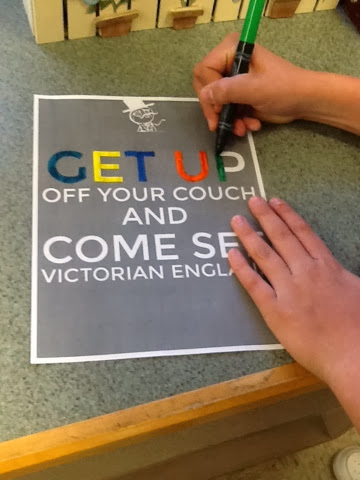

What do I love about this endeavor so far? I love that they are able to implement the element of pretend and play while still creating for an authentic audience. I love feeling confident that they will be able to more effectively connect the historical context of A Christmas Carol with the story's message, and thus connect the story's message more effectively to their own lives. These are all, for me, successes. But what I love most about this project is that they are almost completely in control, and they are coming up with ideas that I couldn't have thought of even on my best and brightest post workshop reenergized idea filled teacher day. They are truly owning the learning.
So, we are building a museum. Literally. My classroom is slowly beginning to transform from just your average 7th grade classroom to full scale Victorian England museum. Although I'm only partially through this process, and the end result is yet to come, I couldn't be more excited about how it's going.
One of my goals in designing this project is to be as hands off as possible. I want them to own every piece of this museum from the beginning of our research to our opening day. I've provided some structure and guidance, but I'm really interested in seeing how they interact with one another, how they problem solve amongst themselves, and what they are able to create without the limitation of a menu of choices or a rubric.
At the start of the research process, students were asked to log onto their edline page, and find the folder with their topic on it. Inside the folder, I placed 2 very simplistic resources which give the students just a taste of their topic, but left many questions unanswered. After reviewing a Prezi detailing how to create well written research questions, students were asked to write 3 big picture questions (I called them "forest questions"), and for each of their big questions, they were asked to develop 3 small detail questions (I called them "tree" questions). They based their subsequent research off of those questions. I wanted them to take the direction in their research that they were interested in taking, rather than giving them specific questions to answer.
I loved watching them navigate through the research process. I gave groups the freedom to divide the research task however they wanted to, and it was fascinating to see the different ways that groups chose to do this. Some individuals had difficulty with group members not being on task, or feeling like they were doing all the work, or not being given any work to do. When they ran to tell me, rather than step in and make decisions or point fingers, I asked guiding questions to move them towards problem solving as a team. I asked questions like, "What is the goal you are trying to accomplish today as a group? What is stopping you from moving forward towards that goal? How can you work together to solve the problem?"
Each day in this process begins with a group meeting, where the "exhibit directors" read the memo from the "museum curator" (me.) The memo requires them to submit a goal for the day to their curator, and briefly explain how each group member will be contributing to this goal. Bringing this element of pretend and play into the activity has proven to be incredibly motivating. I hear things like, "Guys, our grand opening is in two weeks, we really need to get moving!"
I've also asked each group to create an advertisement for our museum. Some groups are recording 15 second commercials and podcasts, others are creating flyers and announcements to be read over the intercom. I've overheard groups saying things like, "We really need to make something that catches their eye!" or, "What parts of the building do sixth graders spend time in? Let's hang some fliers there," or, "Let's tell them a little bit about our topic, but not everything. Then they'll want to come see what it's all about!"
What do I love about this endeavor so far? I love that they are able to implement the element of pretend and play while still creating for an authentic audience. I love feeling confident that they will be able to more effectively connect the historical context of A Christmas Carol with the story's message, and thus connect the story's message more effectively to their own lives. These are all, for me, successes. But what I love most about this project is that they are almost completely in control, and they are coming up with ideas that I couldn't have thought of even on my best and brightest post workshop reenergized idea filled teacher day. They are truly owning the learning.
Monday, October 7, 2013
Differentiating in the Digital Age
Sometimes, the task of differentiating instruction can be daunting. It can be even more daunting when you are a teacher of literacy, and you have students covering an immensely wide range of abilities in reading and writing. I've often grappled with trying to effectively reach and engage all students along this continuum without moving too quickly for some students, while at the same time not nearly quickly enough for others. I found that no matter the pace at which I taught writing skills, there were inevitably always students who grasped the skill the first time through, and in the same breath, students who were desperately struggling to catch up.


This summer, I took a course on teaching writing which emphasizes the writer's workshop approach, an approach I really connected with when keeping in mind the variety of students I have in my classroom. This approach allows me to conference with students throughout the writing process, instead of waiting for them to turn in a rough or final draft to determine if a student needs help with a specific writing skill. One of the things I love most about professional development is that I can take what I've learned and mold it to my style and craft as a teacher. And, if you know anything about my style and craft, you know it includes technology.
The pedagogy-changing decision I made to more fully incorporate technology and BYOD into my classroom has helped me enormously to facilitate the process of personalizing learning, and when combining that with the new strategies I've learned in the writer's workshop class, I've found great success in the teaching of writing in an inclusion classroom.
Right now, we are finishing up our narrative writing unit. Students are working on developing their own personal narratives. Our slogan for this unit is: small moment, big meaning! We are working on a variety of skills, all of which students are learning at their own pace.
Once the "from the heart" drafting is complete, students receive 2 checklists, one for revising, and one for editing. I ask students to keep the checklists on their workspace the whole time they are working. That way, I can get an at-a-glance picture of where students are in the process.
The revising checklist:
The revising checklist contains reviews of 3 mini lessons that were taught live the week before using mentor texts to demonstrate what great narrative writers do. For this unit, we worked on setting the scene (writing interesting leads), digging deeper (adding figurative and sensory language, dialog, and thoughts and feelings), and so what?? (making sure our narratives have a purpose).
Students were asked to watch a video, and revise thier drafts according to the strategies they just learned about. Because the lessons were reviewed in the form of a video, students could watch them as many times they needed to, and most importantly, revise at a pace that works for them.
When the revision checklist was complete, they moved to their editing checklist...
This checklist added another dimension. Once they watched a video on an editing skill, they were asked to take a quick electronic quiz on their English edline page to check for understanding. These were very quick, formative assessments that get reported immediately to me. I can very quickly check in with students who are not understanding the editing skill, and reteach as necessary.
There were an infinite number of reasons why I felt like this approach to teaching writing was one of the most successful I've tried so far.
1. Students are truly working at their own pace. They know they are held accountable for all of the information presented, but they don't have to deal with the added stress of missing something important during the teaching of the lesson. For those students who find writing a natural and painless process, they are able to work through the revision process without the boredom of waiting for others to finish.
2. I get to give immediate feedback. While students are working on their checklists, I have the freedom to move around the room, and find those struggling students to conference with. Receiving the immediate feedback on the quizzes also helps me to identify where skills are strong and where they need further development both within the large group and amongst individual students. I don't have to wait until all 105 quizzes are graded to find out who is struggling with a concept.
3. The amount of "less with the jaws more with the paws" reminders I need to give my seventh graders during the revision process has been DRAMATICALLY reduced. I get to spend less time making sure students are on task, and more time making sure they are truly building and growing their writing skills DURING the writing process, instead of waiting until it is complete.
It's pretty blissful, actually.
Thursday, September 19, 2013
Beginning with BYOD
As a teacher entering the profession in the 21st century, integrating technology into my classroom has always been a priority of mine. When I was given the opportunity to participate in a districtwide Bring Your Own Device program 3 years ago, I jumped at the chance. I quickly realized, however, that I had absolutely no idea what I was doing. Even though I used technology every day to organize my personal life, I had little practical understanding of how to apply that to my classroom. I had many days where in four class periods, I accomplished absolutely nothing. In fact, many days I think I actually aided my students in the rarely practiced yet impressive art of unteaching. I left the building many days feeling frustrated and exhausted. To put it frankly, it was quite terrifying. It was truly one of those learn as you go experiences, where you feel like you make a million mistakes before you can even take one hesistant step forward. Looking back, there are lots of things I would've told myself, and I'm hoping some of you can benefit from this retroactive advice!
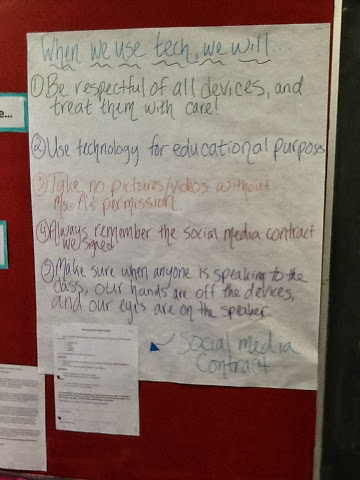


1. Create and post routines, expectations, and procedures for using technology.
Duh. Of course setting routines, expectations, and procedures is important. It's the first thing we do to maintain management. But when I was in the excited frenzy of trying something brand new, I neglected to acknowledge that it needed to come with its own set of expectations. When my classroom had turned into Bedlam, I knew I needed to start over. Now, once my classroom is already running well, I spend time setting separate routines, procedures, and expectations specifically for using technology. I start by asking my students to brainstorm how they envision using technology in our classroom, and what they think is important in order to keep our classroom running smoothly. I like including students in this process to promote ownership and responsibility. I make a giant list of everything they come up with, and pool their ideas into a set of 5 simple, convenient, and visible expectations.
I also ask them to sign a social media contract, which is shaped by our school's core values of respect, responsibility, and honesty.
As in all endeavors we take on as teachers, when students understand and agree to what's expected of them up front, it allows us to be proactive classroom managers, instead of forcing us to waste time and energy putting out fires all over the place.
2. Loosen your grip. You are now a facilitator.
I can't say this enough. When you are incorporating BYOD into your classroom, it will get messy. Like really messy. You'll have days where kids are unimaginably perplexed, and days where the app that worked perfectly last period is now not working for no solvable reason. You'll have days where you will hear the same question asked enough times to make you want to rip your hair out. Just roll with it. Thank your students for their patience, and stay calm. Remind them that you are all in this together, and we can learn from what went wrong today. Don't run to their rescue with step by step directions for each task. Don't answer the same question more than three times; direct them to a classmate for who has already received the answer. Otherwise, you will literally drive yourself insane. Ask them to problem solve and encourage them to try something before asking the inevitable question, "What do I click next??"
3. Teach and model technology etiquette.
You know when someone swears they are listening to you, and they nod their head giving the impression that they are listening, but at the same time scrolling through Facebook or checking their email? Then you discover, after blabbing on for quite some time, that that person has not truly processed one word of your hilarious story? That's similar to what happened in my classroom when I tried to give directions once students were fully engrossed by their devices. I think the most important expectation, and the one that takes the most practice, is that when anyone (student or teacher) is speaking to our class, hands are off our devices and eyes are on the speaker. It even takes practice for me, and I've had to train myself not to be playing around on my ipad while my students are asking me even the smallest questions. By getting students in the habit of understanding there is a time and a place, we can help them to be respectful and responsible users of technology. We want them to be well versed in technology, while at the same time remembering how to respect and listen to one another.
4. Start small, and build slowly.
Don't try to incorporate BYOD in every facet of your teaching right out of the gate. It will turn out a lot like learning to juggle by throwing 5 balls into the air at once. It will fail miserably, and you might get hurt. Start by incorporating one app, and using it once or twice a week. When it's working really well, introduce something else. A great app to start with is Socrative, a response app that allows students to answer open ended questions and take quizzes using thier mobile devices. It's very user friendly, and it works like a charm.
5. Learn and take advantage of social networking.
If I were asked to give one single piece of advice to any teacher at any point in their career, it would be to join Twitter. You can create a Professional Learning Network made up of teachers from around the world. It's fantastic. It's like a daily mini dose of professional development. It's a great place to share what you're working on in your classroom, and to experience what other teachers are working on in their's. As an added bonus, you can find out what Justin Timberlake ate for lunch, if you're interested in that sort of thing. Follow me @JennaleeA. I promise I won't share with you what I ate for lunch.
Other great social networking sites worth joining and exploring are:
-Pinterest (a virtual pinboard)
-Goodreads (Great for ELA teachers. Keep track of, review, and share books you're reading)
Although it's absolutely been a tumultuous journey, incorporating BYOD into my classroom has been incredibly valuable. I love the idea that bringing devices into my classrom allows education to change and develop in the blink of an eye. Even more so, I love the idea that it allows me to instantaneously connect my students with the world around them.
Wednesday, September 11, 2013
Starting Up Strong
Even though I am 5 years into my career as a teacher, and I've gone back to school on a yearly basis since kindergarten, the first day of school still carries that same nervous excitement I felt at 5 years old, standing in front of my house, waiting for the bus, wondering if Mrs. Minton would like me. Only now, I find myself on the other side of the equation, and that nervous excitement is manifested in making sure my learning space is perfectly arranged, reading over my class lists, and trying to picture a fresh batch of seventh graders wandering into my classroom.


It's obvious that those first days of school are imperative in terms of establishing routines and procedures and setting the overall tone of the classroom. In years past, my focus has always been not only creating and practicing a procedure for just about everything, but also setting the tone by making sure my students knew that I was in charge. My classroom door was adorned with only my name, room number and the class I taught. When the students entered on the first day, I had the desks in rows alphabetically. I read lists of rules, and tried my hardest not to smile. I had to make sure they knew that MY students need to follow MY rules in MY classroom.
I have to admit, though I continued to start the year this way, it felt unnatural and unwelcoming. I found myself stumbling through the first days of school until I could get to that point in September where I could become my real teacher self. So, I decided to try something different this year. My teaching philosophy has evolved as I've learned more about being a middle school teacher, and my goal was to make sure my students' first days of school fit well with my mission of creating an inclusive and empathetic community of students.
Door Deco
All year long, I change up what my door looks like. It's one of my favorite features of my classroom. I wanted this to be a part of my identity as a teacher from the start. So, Instead of starting the year with my door displaying only my name, classroom number, and the subject I teach, I tried this...
The Power of Pronouns
A pronoun can make all the difference in the world. I'm not just saying this because I'm an English teacher. While looking over my class expectations document, I couldn't help but notice how many times I used the words: I, me, my, you, yours, etc. From day one, I was already sending the message that it was me against them. The classroom was my classroom. You were responsible for bringing a pencil to class everyday. In an environment where I was trying to encourage community, I felt like I was already tearing down the bridge I'd hope to build between students and teacher. I wanted them to know that we are in this together, and that my responsibilites as a teacher are similar to theirs as students. I wanted them to know that this classroom belongs just as much (if not more) to them as it does to me. So, I infiltrated my expectations to send the message that we are on the same side, and we are working together to achieve success. I changed the I's, my's, you's, and your's, to we's and ours. My expectations document used to open with classroom rules. Now, the opening looks like this...
Starting as a Team
Teamwork is a huge a focal point in my classroom, and seating alphabetically by row on day 1 seemed counterproductive to establishing this important pillar of my philosophy of education. So, instead of standing in the front of the room explaining the different procedures and routines, to rows of students, I placed them in groups right away, and sent them on a scavenger hunt where they worked together exploring the classroom for answers to my questions. I've decided also to rename my daily objective to "Today's Team Goal", and to emphasize throughout class that we need to bring our individual best to the table to be collectively successful in achieving this goal.
Although this was experimental, I am really happy with the sense of unity and community that seems to already exist in my classroom seven days in. I hope that by constantly reinforcing that we are a team, and that we are all here to help each other achieve success.
Subscribe to:
Posts (Atom)